A Brief Essay on Yasujiro Ozu
Jonathan Bloom
AS 150 Prof. Takamiya
Yasujiro Ozu is probably the most well-known Japanese filmmaker and director. His unique directing style was something that was years ahead of his time. More modern filmmakers such as Stanley Kubrick, David Lynch, Chuck Palahniuk, and Peter Jackson all have taken elements of Ozu’s directing style and applied them to create their own style. Ozu was a complicated man who had a fairly difficult and diverse upbringing.
Ozu was born in 1903 in Tokyo as the son of a fertilizer distributor. He had a larger family, with four siblings. At age 17, after living in a dormitory at a school for several years, he was kicked off of campus allegedly for writing a love letter to a younger male student. This story, albeit unverified, suits Ozu. The fact that he went unmarried and and never had an active, obvious relationship with a woman supports the idea that Ozu was a homosexual. Further support for this can be found in his films, which sometimes dealt with very risque topics. More commonly however, his films concentrated on family dynamics and especially marriage. He commonly had characters in unwanted sexual or marital situations. Ozu was never particularly interested in his studies, commonly skipping class to go see films.After working for several years starting in 1923 as a cinematography assistant, Ozu started directing. At first, he directed silent films, of course in black and white, and was not really anything particularly special as he was still defining himself as a director. His really great work was more serious and really only began after WWII, when Ozu had been drafted into service and captured by British forces in southeast Asia. His greatest accomplishment came in 1953 with Tokyo Story, regarded as not only Ozu’s best film, but one of the best films ever made.
As far as Ozu’s cinematographic style goes, not much of what he does would be particularly revolutionary or special in today’s world, but the fact that Ozu was doing it 50 years before it became popular was really what makes him special. He was the first director to commonly break the “180 degree rule” which is when the camera flips sides when two characters are talking. Ozu’s trademark shot was an exceptionally low shot, known as a “tatami shot”. He would often start a shot before any characters were in frame, which was unheard of at the time. He also did not use transitions frequently, preferring to take a few seemingly random shots of static things before going to the next scene. As color found its way into cinema more, Ozu was one of the first to experiment with color as a theme or motif.
The 180-degree rule
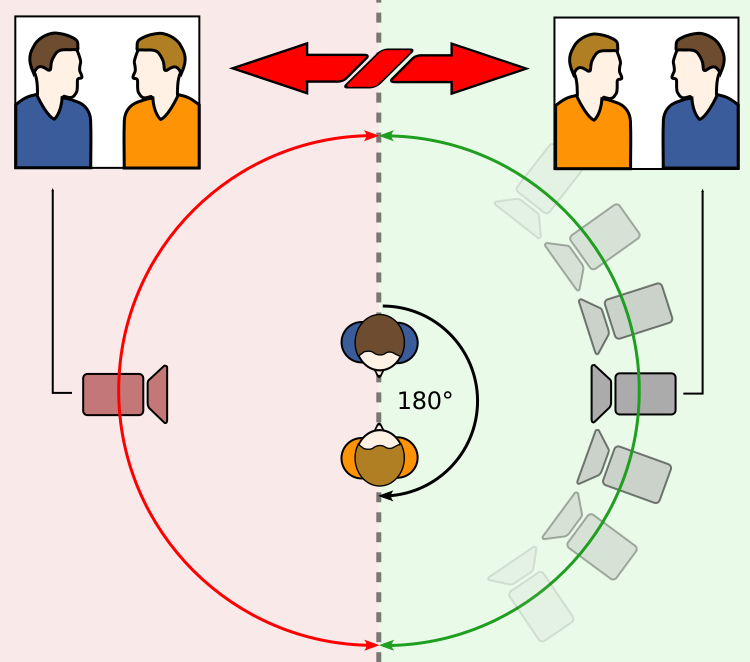
Ozu not only experimented within the cinematography of film, but also through its narration. He was the first director to commonly use ellipsis, that is, leaving out portions of the story, and simply implying them, rather than showing them. He would sometimes go out of order in the narration, something that only really became popular in the US with Stanley Kubricks Clockwork Orange.
Ozu frequently used marriage and family dynamics as plot devices in his films, but much of that probably stemmed from living in a very domestically structured culture. He truly changed the course of cinematic history with his directing.
*Here is a clip of Peter Jackson’s The Lord of the Rings: Two Towers, which shows great use of the breaking of the 180-degree rule.
http://www.youtube.com/watch?v=DLvIFRNbqOs&playnext=1&list=PLDEF0AD97C610C1C2&feature=results_main
Notice how the first few shots show both backgrounds behind Gollum in a continuous motion so that it establishes that he is in the same place (00:12 and 00:25), and not talking to someone else. Jackson then switches to having a totally different shot for every line of dialogue (00:39). This stylistic choice is why the scene seems so creepy, and it was developed by Ozu.

